CONTENT WARNING: The following blog post features images and discussion of materials in the Denzil Ridout fonds. Photographs featured in this fonds were taken amid tours of the United Church of Canada’s mission sites. While images directly linked to these sites are not included in this blog post, the Morley Residential School is referenced. Materials of this nature can be upsetting, please make any necessary preparations prior to viewing. The Indian Residential Schools Crisis Line at 1-866-925-4419 is available as needed.
The holdings of the United Church of Canada Archives (UCCA) span centuries and often reflect the historical biases of not only record creators, but also the archivists describing these materials. In 2019, the Archives began the process of evaluating its legacy archival descriptions for offensive and harmful language and practices. Since then, the Archives has been engaged in remedial work on the descriptions of images to allow for more equitable and just practices.
The Denzil Ridout fonds is among the materials considered in this remedial work. In the following blog, I reflect on the work involved in redescribing Rev. Denzil Ridout’s photo albums to allow for greater and more equitable access in the enduring future.
Context
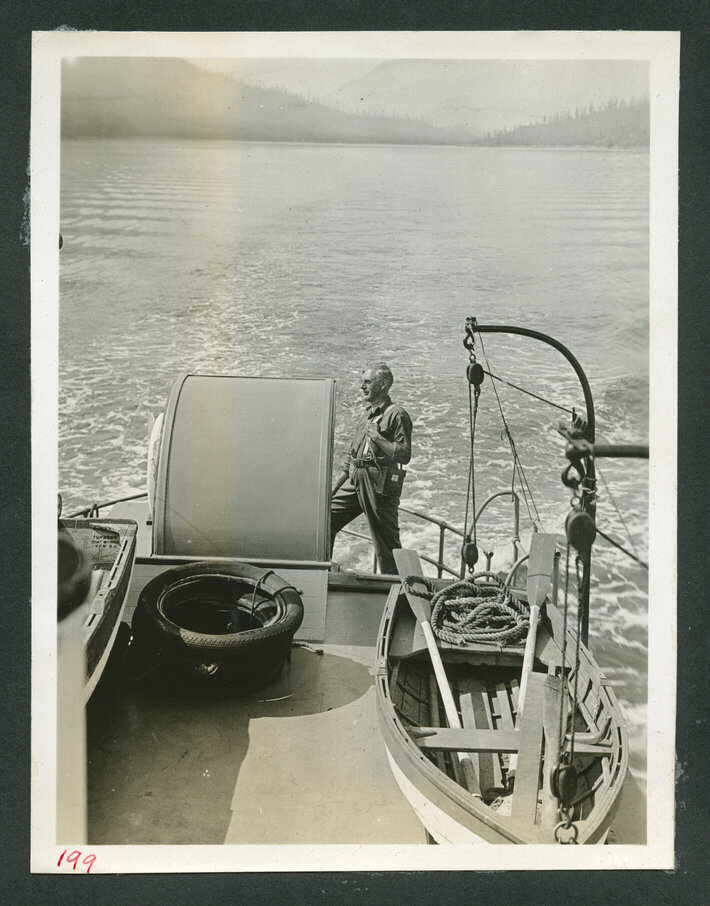 Accession: UCCA, 1986.229P/5.199,
[Denzil G. Ridout in boat – travelling].
Rev. Denzil G. Ridout (1886-1954) was a Methodist and United Church minister and administrator. Rev. Ridout worked in Methodist Book Rooms in London and Montreal before joining the United Church of Canada upon union. Between 1925-1939, he served as Editor of the United Church Record & Missionary Review. He later served as Secretary of the Missionary and Maintenance Committee until his death.
The United Church Record and Missionary Review often featured photos and accounts from Rev. Ridout’s travels. His travelogues were also published in the Toronto Star Weekly and Canadian Geographical Journal. He also gave lectures and pictorial presentations across Canada.
The Ridout fonds contains diaries, notes, newspaper clippings, and ten photo albums containing thousands of photographs. These albums will be the primary focus of this blog post.
Why (re)describe it?
When accessioned in 1986, Rev. Ridout’s albums were described by their subject matter: either domestic or foreign travels. There were no individual descriptions created for the images contained within these albums.
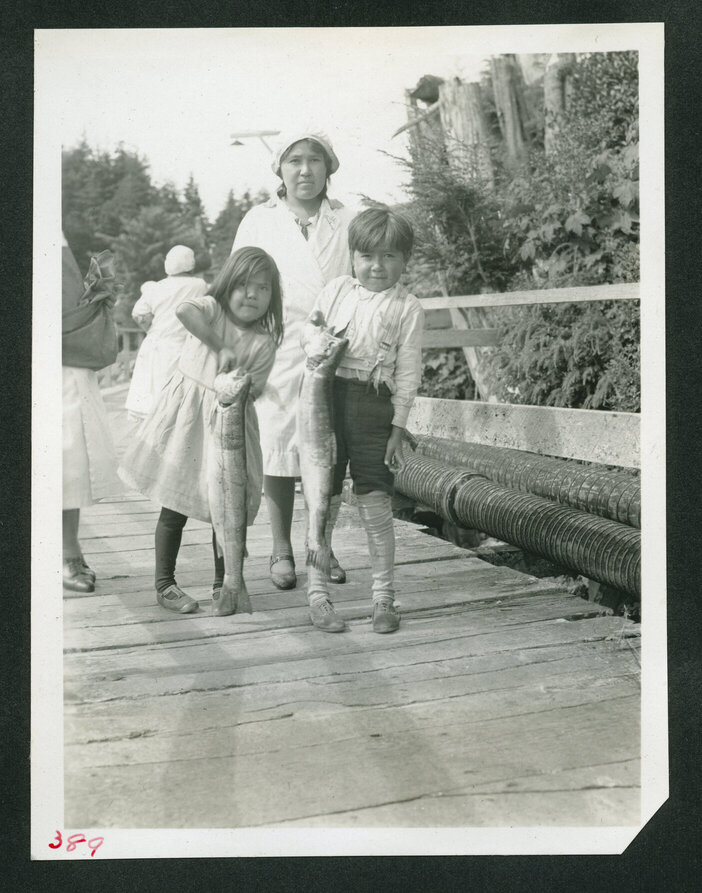 Accession: UCCA, 1986.229P/5.389,
[Mother and two children holding caught fish].
The Archives has since returned to the Ridout albums for their inclusion of photographs relating to residential institutions (historically referred to as residential schools). In 2012, albums which were identified to contain residential institution images were digitized and submitted to the Truth and Reconciliation Commission. In 2023, Digital Archives Systems Lead, Erin Greeno, added item-level descriptions of photographs taken at residential institutions to the UCCA’s AtoM catalogue.
Reconciliation work at the Archives has expanded in scope following the conclusion of the Truth and Reconciliation Commission. As we work towards providing communities with more robust access to materials related to missions, hospitals, and day institutions, continuing the work of redescribing Ridout’s photographs was necessary. It was also necessary to approach this work within the ethos of the UCCA’s anti-oppressive work with a person-centred approach.
Archivists Jennifer Douglas, Mya Ballin, Jessica Lapp, and Sadaf Ahmadbeigi have defined person-centred approaches as a shift in attention. They argue, traditionally, archives have been almost exclusively focused on the record itself; a person-centred approach instead considers “the people who create, keep, use, and are represented in records.”
More specifically, within the Ridout fonds, (re)description is a way in which I have attempted to move beyond the album as a record. Instead, while either creating new descriptions or revising old ones for this album, I have aimed to consider each individual represented within each photograph, as well as the perspective of Rev. Ridout himself as the photographer who created, kept, and used these images as part of Church publicity.
The (re)description process
The Ridout fonds contains ten albums. However, as this redescription effort was born out of the archives’ reconciliation efforts, I focused primarily on photos related to home and marine missions (contained in albums one through five). It should be noted that the remaining five albums contain rich evidence of the lives of people in Europe and Africa. We hope to be able to include these albums in future remedial efforts.
Each album is presented differently:
The Canadian archival descriptive standard, Rules for Archival Description, recognizes information found on the record itself as the chief source of information for graphic materials. However, in instances in which Rev. Ridout’s labels use outdated or even derogatory language, I have instead intervened to replace harmful language. This is in line with the UCCA’s Guidelines to Anti-Oppressive Description/Redescription to opt for community terminology when possible. In such examples, I hold the perspective that this is a way to centre and respect those represented in these photographs.
Creating and revising the descriptions present in this fonds required several different strategies and considerations. As I continue this blog entry, I will dive into some of these distinct approaches.
Following an information trail
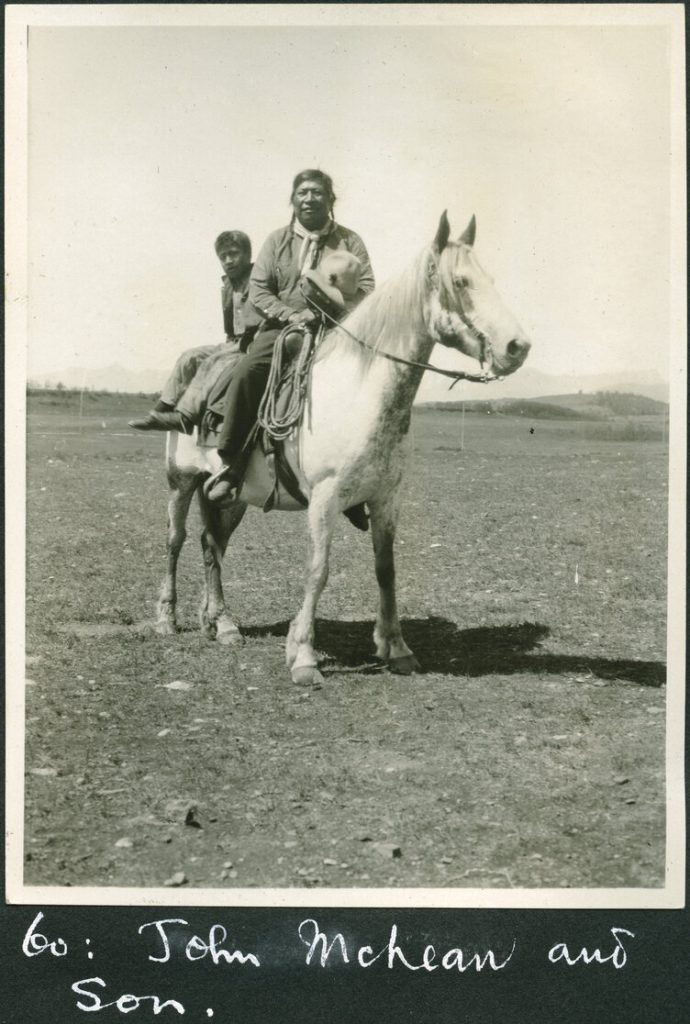 Accession: UCCA, 1986.229P/2.60, [Chief Walking Buffalo (George McLean) on horseback with child].
Inside the [Tour of missions in Alberta, Saskatchewan, and Manitoba] album is a photograph of a Stoney-Nakoda parent and child near Mînî Thnî (formerly Morley). Underneath this photo is an inscribed caption by Rev. Ridout which describes the subjects as “John McLean and son”. As part of our archival intervention, this description was revised to correct a possible human error and reflect community knowledge.
As Rev. Ridout was the Editor of The United Church Record and Missionary Review it was an important source throughout this redescription project. In an article titled, “Home Missionaries I Have Met,” Rev. Ridout wrote of meeting Principal E.J. Staley, George McLean, and his child outside Morley Residential School. He also included a photograph of the three which correlated with the image held in his albums yet contradicted the inscribed caption. The identification of George (and not John) McLean in this published material suggested a human error.
Chief Tatanga Mani (Walking Buffalo), also referred to as George McLean, is featured in other UCCA records and in wider literature. His experience at Morley Residential School was also discussed in an account by his son, William McLean, included in the Legacy of Hope Foundation’s Our Stories… Our Strength series. In his Survivor Story, William McLean explains that his father was given the name George when he was taken away to the residential institution by the missionary Rev. Dr. John McLean.
Ultimately, in redescribing this image, I have tried to reconcile as much of the breadth of information imbued within it as possible. Both names are present in this description in recognition of the names Chief Walking Buffalo held in these different contexts. I have removed assumptive language in acknowledgement of what I do not know but I recognize I remain bound by my perspective as a settler-researcher amid the depth of knowledge that communities hold that are yet still to be reflected in this work.
Connecting the dots
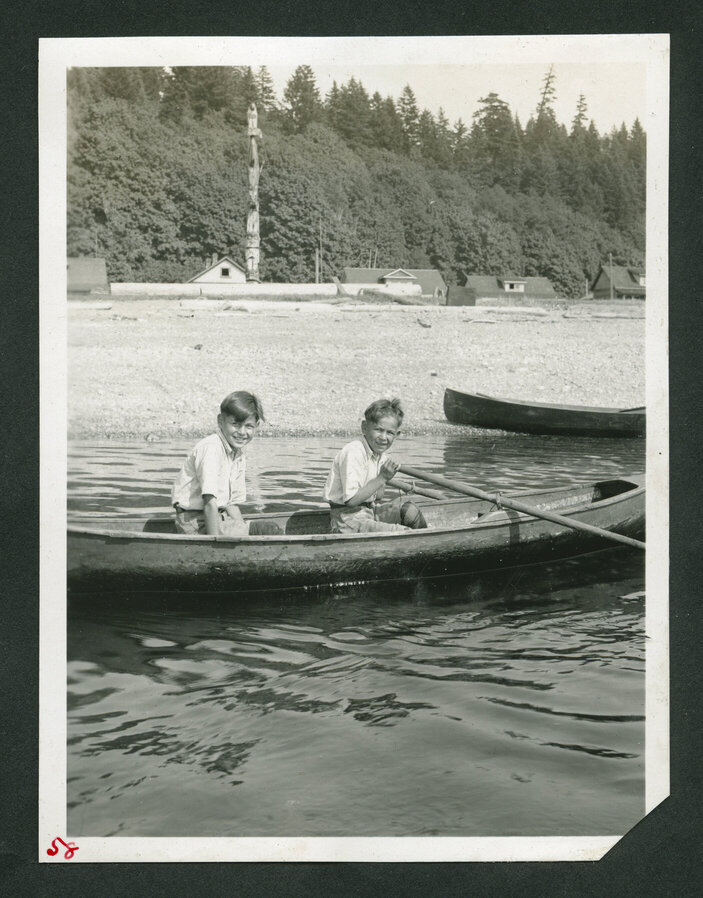 Accession: UCCA, 1986.229P/5.58, [John Wesley Dix and George Ivan Dix rowing canoe, Cape Mudge].
Though captions and photo lists accompany some photographs in the Ridout fonds, [With the marine missionaries on the Pacific coast] is unique as it is the only album in which most descriptions have been sourced from Ridout’s personal papers.
Unlike a traditional bound diary, Ridout’s 1932 trip to the Pacific Coast is documented in typewritten notes which include partial accounts of his travels and photo descriptions for future lectures.
One image described using these notes is 1986.229P/5.58 – [John Wesley Dix and George Ivan Dix rowing canoe, Cape Mudge]. In his notes, Ridout presents a description which seemingly matches the image below. As this image is presented in the album alongside other images of Cape Mudge, I discerned that this image could be contextualized further.
However, as with the misnaming of Chief Walking Buffalo or in another image in this album, 1986.229P/5.42 – [Stella Cooper standing in front of Carman United Church], there remains the possibility that Ridout may have misidentified these children. These noted and potential discrepancies call for the need to be further in conversation with communities themselves. As the UCCA continues consulting with and building relations with communities, such descriptions remain open to reiteration and future redescription.
Look, I made a description… Where there never was a description
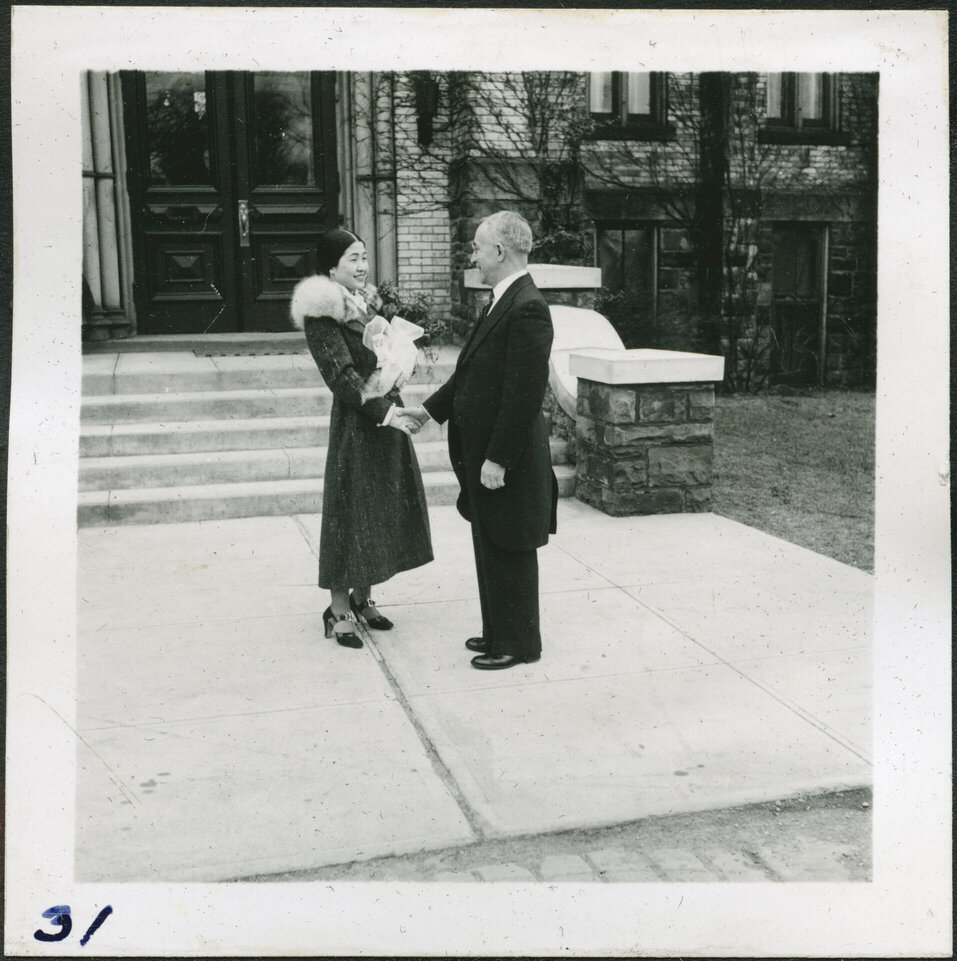 Accession: UCCA, 1986.229P/4B.31, [Pyughyong Rhu and Principal Dobson, Alma College].
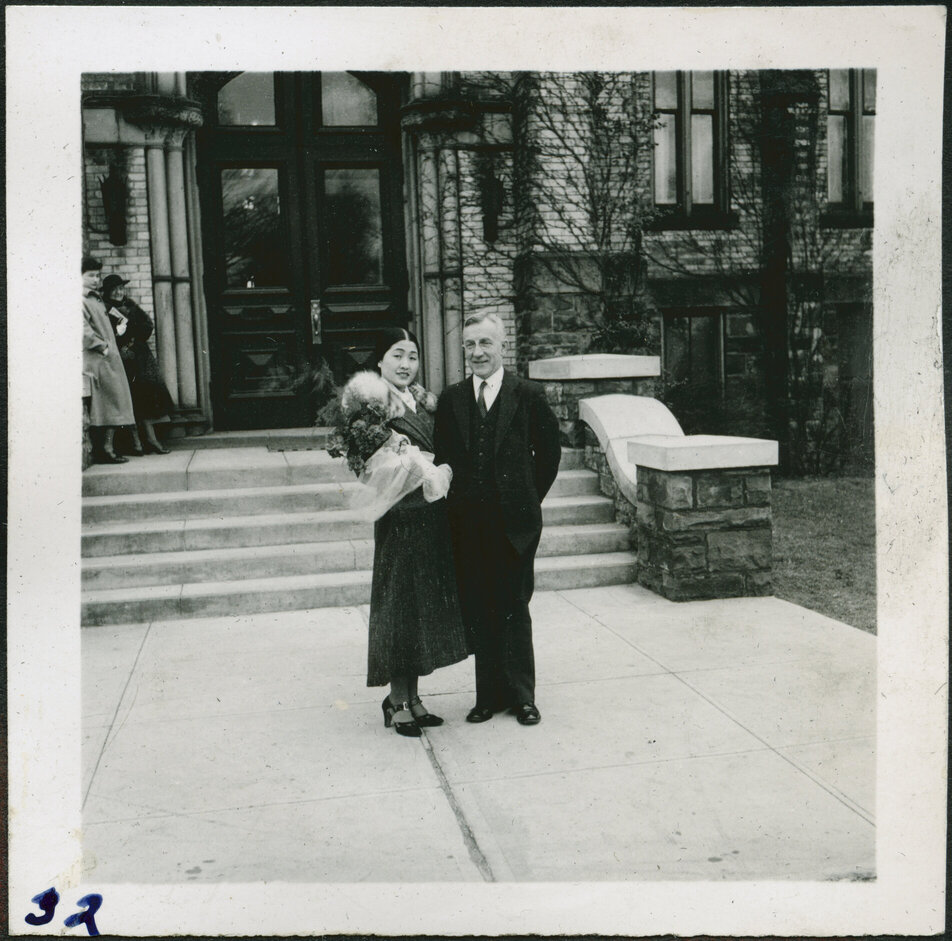 Accession: UCCA, 1986.229P/4B.32, [Pyughyong Rhu and Principal Dobson, Alma College].
For some images in the Ridout albums, it was necessary to work from the ground up creating descriptions from the contents of the images without written descriptions by Ridout to aid this work. This was the case with 1986.229P/4B.31-4B.32: [Pyughyong Rhu and Principal Dobson, Alma College].
An initial glance at these photographs suggested a graduation due to the formal wear worn and bouquet held. To place this photograph, I turned to image recognition technology. Running the image through Google Lens, I was directed to the Elgin County Archives’ Alma College fonds which held similar images. As with the use of any technology, this required further human intervention to confirm its accuracy. Delving more into their Alma College fonds and digitization projects suggested that this initial identification may be correct and that one individual featured in this photograph may be Principal P.S. Dobson.
This prompted a search of the UCCA’s materials related to Alma College. Photos we hold of the exterior of Alma College seemed to confirm the place of these photos. Furthermore, among our digitized publications, I was able to locate an article, “The Dominion Board” by Elizabeth M. Turnbull for The Missionary Monthly, published in August 1936. In this article, an image of the young person in Ridout’s photograph is present and identified as Pyughyong Rhu. Additionally, the article speaks to her presence at Alma College to receive a World Friendship scholarship in support of her musical studies.
Following that thread, I visited the Internet Archive to see what a search of Pyughyong Rhu could yield. An issue of The Korean Mission Field published in 1938 names her as a graduate of Alma College and the Toronto Conservatory of Music. Other periodicals refer to Rhu’s performances across the country, including to United Church of Canada summer camps.
In the interest of timely description, this level of investigation could not be applied to every single photograph in the Ridout albums. However, the process embedded in describing these two images in turn helped contextualize other photographs in the album taken at Alma College and featuring either Dobson or Rhu.
Conclusion
The redescription of the Denzil Ridout fonds is one project among several undertaken as part of Anti-Oppression Work at the UCCA.
This work has been the product of years of work by UCCA archivists (past and present) in consultation with leaders in Anti-Racism and Equity at the Church, as well as members of Indigenous Ministries and Justice. As we continue to create and reiterate descriptions, we recognize the importance in accomodating shifts in knowledge and greater community input.
This iteration of the Ridout descriptions may just be one step towards more comprehensive and community-informed descriptions in the near future. If you are interested in providing feedback related to these descriptions, please get in touch.